Below you will find more evidence that I am (1) a country girl, (2) terrible with machines, and (3) likely to one day have an interaction on the street not go so well.
My housemates let me borrow their car for the afternoon, so yesterday I ventured down to Brattleboro for a day of shopping at the co-op and generally eating too much.
I know how co-ops work. Nothing at all strange there. Unless you want to count the men in skirts and lipstick doing their grocery shopping as strange, but I call that fucking awesome.
The general situation gets slightly more embarrassing and interesting as I stand in front of the "pay and display" meter at the public parking lot, baffled for all I'm worth as to how it works.
This is the part where a friendly stranger steps in to help the visibly incapable girl who JUST WANTS TO PARK WITHOUT GETTING TOWED, OK?
Used to lots in Minnesota where you get a ticket, stay as long as you like, then return the ticket and pay for the amount of time that you've parked, the name "pay and display" passed straight over my head.
You pay first. Then you get a ticket and display it on your dashboard, the friendly stranger explains.
This leaves me with mental palm to mental face. The obvious always escapes me.
They say you never know who you'll meet in Brattleboro. It's full of artists, organic hippy nutters, graduate students, and, in the warmer months, people without tops on. (There are apparently a distinct lack of public indecency laws in the town.)
The friendly stranger turns out to be Boxcar Jim, a semi-itinerant, sometimes-musician who was just kicked out of his on-again-off-again girlfriend's house last night and could really use any spare change you might have.
Will 30 cents do? I just spent all my change in the meter.
Sure. It was nice to meet you.
Somewhat wide-eyed and with my culturally conditioned damsel in distress instincts switching on, I walk away thinking about how little I really know about living in a city.
Boxcar Jim wasn't actually dirty or rude or threatening, as city people often characterize the less fortunate. He was kinda cool.
Did he "take advantage" of me by asking for my spare change after helping me? No more than the friendly stranger as the service counter earns their wage by helping you.
It all makes me wonder whether I could live in a city. Maybe I like to keep my eyes wide.
Sunday, January 26, 2014

Sunday, January 12, 2014
Art, Awe, and Adventure
Art, Awe, and Adventure: apparently my top three values according to one of those sappy self-reflection exercises I completed at professional development training a few days ago.
Well, sounds pretty accurate.
In that spirit, here are a few (hopefully) Artistic photos that I took of the Awe-inspiring forest which is my backyard here on my Adventure in Vermont.


Well, sounds pretty accurate.
In that spirit, here are a few (hopefully) Artistic photos that I took of the Awe-inspiring forest which is my backyard here on my Adventure in Vermont.
What if we ascend the fallen trees? The forest grows anew.
Saturday, January 4, 2014
I'd Be Outside, If I Could
Our attempts to stay warm involve electric heat, two fires, and quilts covering all the windows.
That's because it got to 14 degrees below zero last night, people. Negative 14!
Alright, so it's not the worst temperature I've ever lived through, but it is really cold for Vermont.
A house with two-story floor-to-ceiling picture windows is not built for this kind of cold.
I'm gonna freeze my toes off.
I also wish it wasn't so damn cold because when the weather is a balmy 35, the winter sports rock, as evidenced by the following pictures.
Yours truly went ice skating on a genuine frozen pond.
It's right out of a holiday movie. Including all of the lumps, bumps, and face-plants.
I was told that the neighbors had fun watching me and reminiscing about when they used to be young enough to skate the pond in the winter.
Or watching me face-plant.
Either or.

Later, there was hiking deep into the national forest and across frozen swamps.
But for this weekend, I'm housebound by the bad weather.
Now there's nothing to do but hunker down and prepare for the impending ice storm.
This includes hauling fire wood, hoping the power doesn't go out, baking cookies, writing letters, and dancing around the living room like a goofball.
A pretty typical couple of days, when all is said and done.
That's because it got to 14 degrees below zero last night, people. Negative 14!
Alright, so it's not the worst temperature I've ever lived through, but it is really cold for Vermont.
A house with two-story floor-to-ceiling picture windows is not built for this kind of cold.
I'm gonna freeze my toes off.
I also wish it wasn't so damn cold because when the weather is a balmy 35, the winter sports rock, as evidenced by the following pictures.
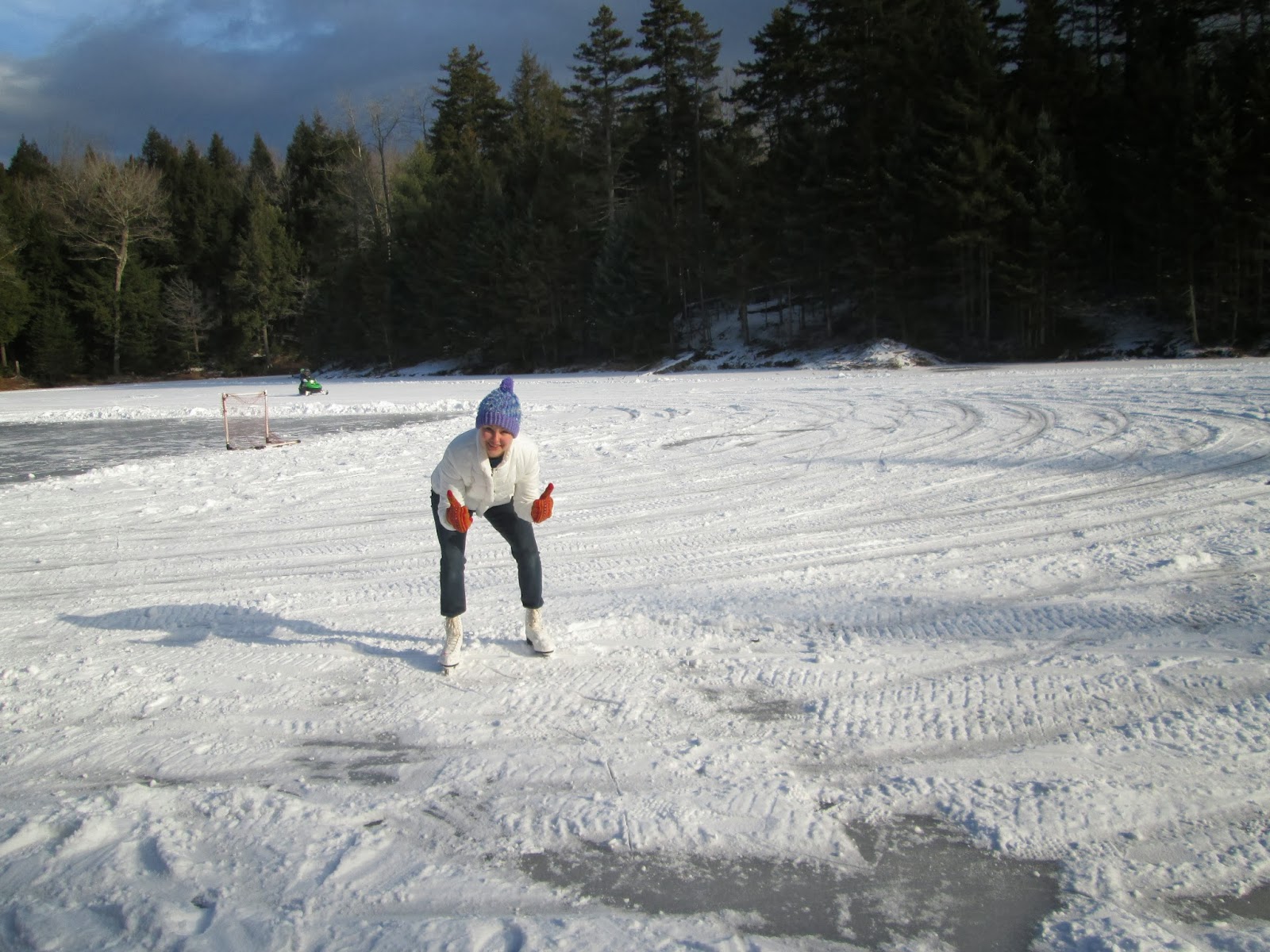 |
| Don't I make a picturesque postcard with a hockey goal and a five-year-old on a snowmobile zooming through the background? |
It's right out of a holiday movie. Including all of the lumps, bumps, and face-plants.
I was told that the neighbors had fun watching me and reminiscing about when they used to be young enough to skate the pond in the winter.
Or watching me face-plant.
Either or.
 |
| Slightly closer up! |
Once I activated some muscle memory and could manage to call myself a decent skater, I took my little housemate around the pond.
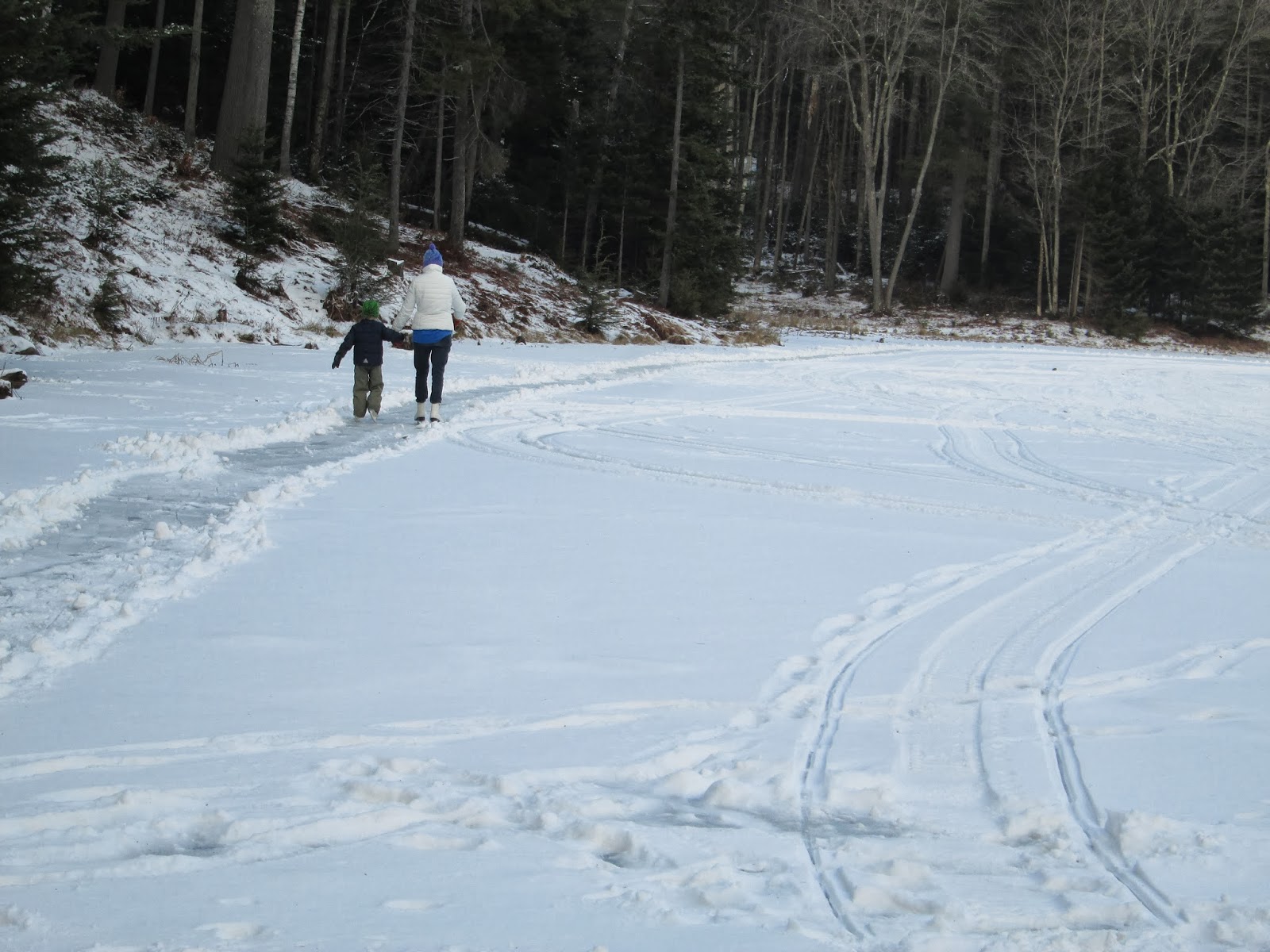
Later, there was hiking deep into the national forest and across frozen swamps.
 |
| I couldn't resist throwing in a little G. |
Now there's nothing to do but hunker down and prepare for the impending ice storm.
This includes hauling fire wood, hoping the power doesn't go out, baking cookies, writing letters, and dancing around the living room like a goofball.
A pretty typical couple of days, when all is said and done.
Thursday, December 26, 2013
Christmas, Caffeine, and Minnesota Public Radio
A story of sweet, sweet Christmas gift mockery
and why I turned the radio up too loud.
I'll admit that my family back home has never been big on decorating for Christmas, but my Vermont family takes holiday decorating to an entirely different level. One day a few weeks ago literal boxes of Christmas goods were unpacked and festooned about. They even switched out every dish in the house to something Christmas-themed. Plates, mugs, bowls. All of it.
Well, I guess I was spared the silverware. They used to change that, too, but find it too be too much of a hassle.
The sudden upsetting of what had finally become familiar and part of a comforting routine was too much for me. Panicked by the foreign tradition, I asked, "Can I at least keep my favorite coffee mug out?!?" I don't think it too much of a luxury to want comfort in my morning cup of coffee.
Yet the reply was a ribbing, "No! It's not Christmas themed!"
Woefully and grumpily, Christmas came between me and my caffeine.
However, a joyous thing happened on Christmas morning. I was gifted by my Vermont family a giant, obnoxiously-colored mug of my very own, just like the favorite they had insisted I put away.
The Christmas dishes are still in the cupboards, but I can parade around the house drinking my coffee out of my not-even-remotely-holiday-themed mug saying, "Hah! You can't force me to put it away! It was my CHRISTMAS gift!"
Oh to be properly caffeinated!
But that's not even the end of the story.
As I listened to the Current from Minnesota Public Radio today at work, as I often do, they asked listeners to send in stores of the best/worst Christmas gifts they received this year.
As the story of my not-Christmas mug was recited on MPR, I cranked the volume and made my co-workers listen. HEY, I WAS ON THE RADIO, GUYS.
But that's not even the end of the story.
No, I used part of my work day today talking to a DJ who was filling in for the usual host because HEY, IT'S A SMALL WORLD AFTER ALL, GUYS. The man who picked and read my story to all of the listeners turning in at 2:30 EST today lived and worked for four years in Manchester, Vermont, 20 minutes away from my office. We'd been to the same bars, coffee shops, and bookstore. I had even conversed with his ex about lingerie in the underwear shop that she owns.
Merry Christmas, indeed.
 |
| And I made this face. |
The Christmas dishes are still in the cupboards, but I can parade around the house drinking my coffee out of my not-even-remotely-holiday-themed mug saying, "Hah! You can't force me to put it away! It was my CHRISTMAS gift!"
Oh to be properly caffeinated!
But that's not even the end of the story.
As I listened to the Current from Minnesota Public Radio today at work, as I often do, they asked listeners to send in stores of the best/worst Christmas gifts they received this year.
As the story of my not-Christmas mug was recited on MPR, I cranked the volume and made my co-workers listen. HEY, I WAS ON THE RADIO, GUYS.
But that's not even the end of the story.
No, I used part of my work day today talking to a DJ who was filling in for the usual host because HEY, IT'S A SMALL WORLD AFTER ALL, GUYS. The man who picked and read my story to all of the listeners turning in at 2:30 EST today lived and worked for four years in Manchester, Vermont, 20 minutes away from my office. We'd been to the same bars, coffee shops, and bookstore. I had even conversed with his ex about lingerie in the underwear shop that she owns.
Merry Christmas, indeed.
Tuesday, December 3, 2013
Farm Alarm
I recently started reading Barbara Kingsolver's influential book, "Animal, Vegetable, Miracle" which talks about her family's experiment to live one year on only locally-sourced, organic foods. It was published in 2007, so I'm a bit late to the book party; it hasn't been a shocking eye-opener for me. I already know the good majority of what she's written.
That being said, this is the most depressing book I have ever read. Not in the "I am emotionally gripped and brought to tears" way, but in the "it feels as if there is no hope left for our world" way.
None of us like to face the truths that we find unpleasant, even if they're ones that we already knew. I like to live my everyday life and forget that food and farm issues exist. You can't worry every second of the day or you'd go crazy.
But damn you, Barbara, they do exist.
Here's what I've been reminded of up to page 118:
There are people who don't realize that food either comes out of the soil or from an animal.
Farm subsidies cause an excess in corn and soybeans, which are then either processed into sugars and fats which are added to our diet or dumped overseas, causing developing agricultural markets to crash and farms to fail.
Genetically modified organisms.
We use over twice as many calories to make and ship the food we eat when compared to how many calories the food provides us.
One can make the argument that our markets for seeds (and therefore the crops they produce) are literally monopolies. Monsanto supplies 90% of all soybean seeds and 80% of all corn seeds.
Marketers literally sit in strategy meetings, planning ways to put more processed sugar and fat in our diets and make us like it.
Genetic diversity in the world's domesticated food seed supply is declining so greatly, many scientists worry that we could not recover our food security if a major natural disaster occurred.
We don't care about taste. We only care about our food shipping well so that it looks good when it's sitting on the grocery shelf.
We give up our health and the future of our planet so that we can "economize" on food and buy unnecessary, luxury items instead.
And that's just what I could stand remembering in the few minutes I've been typing.
If it sounds a bit alarmist to you, good! I'm ringing the alarm bell for myself.
Who's going to wake us up?
We're the richest nation on earth, yet we have some of the worst food habits. You'd think we'd spend some of our enormous income on the freshest, tastiest food we could get our hands on. You'd think we'd be like greedy children hoarding that stuff that comes out of the ground or off the backs of animals.
But somewhere along the line we got used to exactly three food groups: fat, sugar, and salt. Maybe our animal nature is a bit to blame, but why do so many think these are the only three tastes worth tasting? Or the only three tastes that exist, for that matter?
Damn you, Barbara, now you've made me rant.
But it's true. We've got our priorities all mixed around.
If you don't believe me, go read the book for yourself. Then we can talk.
That being said, this is the most depressing book I have ever read. Not in the "I am emotionally gripped and brought to tears" way, but in the "it feels as if there is no hope left for our world" way.
None of us like to face the truths that we find unpleasant, even if they're ones that we already knew. I like to live my everyday life and forget that food and farm issues exist. You can't worry every second of the day or you'd go crazy.
But damn you, Barbara, they do exist.
Here's what I've been reminded of up to page 118:
There are people who don't realize that food either comes out of the soil or from an animal.
Farm subsidies cause an excess in corn and soybeans, which are then either processed into sugars and fats which are added to our diet or dumped overseas, causing developing agricultural markets to crash and farms to fail.
Genetically modified organisms.
We use over twice as many calories to make and ship the food we eat when compared to how many calories the food provides us.
One can make the argument that our markets for seeds (and therefore the crops they produce) are literally monopolies. Monsanto supplies 90% of all soybean seeds and 80% of all corn seeds.
Marketers literally sit in strategy meetings, planning ways to put more processed sugar and fat in our diets and make us like it.
Genetic diversity in the world's domesticated food seed supply is declining so greatly, many scientists worry that we could not recover our food security if a major natural disaster occurred.
We don't care about taste. We only care about our food shipping well so that it looks good when it's sitting on the grocery shelf.
We give up our health and the future of our planet so that we can "economize" on food and buy unnecessary, luxury items instead.
And that's just what I could stand remembering in the few minutes I've been typing.
If it sounds a bit alarmist to you, good! I'm ringing the alarm bell for myself.
Who's going to wake us up?
We're the richest nation on earth, yet we have some of the worst food habits. You'd think we'd spend some of our enormous income on the freshest, tastiest food we could get our hands on. You'd think we'd be like greedy children hoarding that stuff that comes out of the ground or off the backs of animals.
But somewhere along the line we got used to exactly three food groups: fat, sugar, and salt. Maybe our animal nature is a bit to blame, but why do so many think these are the only three tastes worth tasting? Or the only three tastes that exist, for that matter?
Damn you, Barbara, now you've made me rant.
But it's true. We've got our priorities all mixed around.
If you don't believe me, go read the book for yourself. Then we can talk.
Friday, November 29, 2013
GLUTTONY BOWL.
A crazy thing in and of itself, an even crazier thing for a mostly-vegetarian with an almost-phobia of processed sugar and butter.
I was warned by a previous participant that it would not be a pleasant experience. I would feel like throwing up, and I would not be able to taste the food.
But when in Rome...
 |
| Just to prove the seriousness of the sport, look at that trophy. |
My strategy for the day was continually graze. Just don't stop eating. Don't. Stop. Eating.
Puppy chow, lobster bisque dip, ginger sesame popcorn, fruit and chocolate dip, cookies cookies cookies, hash brown casserole, pasta fagioli, apple crisp. All by 3pm.
Then the preparations for the feast.


Turkey, three kinds of stuffing, two corn puddings, succotash, brussels sprouts, mashed potatoes, sweet potatoes, two cranberry sauces, lefse, waldorf jello salad, and what must've been two gallons of gravy.
 |
| The face that tells of the deliciousness and the agony. |
My plate was labeled "hysterical," a small pile of everything spilling over the sides. But I was slowing down. Things hurt more than they had flavor. It was just as horrible as predicted. I asked if it was appropriate to go curl up in a ball for awhile. "You wouldn't be the first." Nor the last would be my guest, but that couch was the best thing to happen to me all night.
THEN THE PUMPKIN PIE, CHOCOLATE CAKE, COOKIES COOKIES COOKIES, CHOCOLATE PUDDING PIE, AND GIANT CHOCOLATE TURKEY. MAKE IT STOP.
I made it to the 9 pm weigh out time with no trips to the bathroom, to purge or otherwise.
I weighed out at 142.4 pounds, a net gain of 10 pounds on the dot.
After weigh out, all that was left was to calculate percentage of body weight gained for each participant.
I finished with a 7.55% gain. Good enough for second place.
The champion weighed out with a 9.78% gain, and there was no way I could've challenged that.
 |
| In my baggiest pants, totally food-baby preggo. |
I am happy to report the morning after that I did not puke (though the champion did), and that I was able to actually enjoy a modest slice of pumpkin pie at breakfast.
I can always phone in next year, if I want to try for the trophy. But I won't.
Monday, November 25, 2013
Lefse - It's Just Not Thanksgiving Without It!
We populate our tables at any holiday season with traditional, festive dishes that make the occasion special. Perhaps the food makes it special for some symbolic reason, or they may just be the foods we grew up eating and remind us of home.
As proof of this, I spent 12 hours in a kitchen yesterday prepping for Thanksgiving dinner, and it's not even dinner at my house with my family. I am not traveling home this holiday season, so I'm having Thanksgiving dinner with my housemates and their family. And as they graciously said I could do, I'm making an extra effort to put dishes on the table that my family has on Thanksgiving, so it can feel like my holiday, too.
While there is a very specific and very long list of "Thanksgiving foods" at my house every year, there's one thing that I cannot imagine gorging myself on without: lefse. It's just not Thanksgiving without it.
 Lefse is a Norwegian potato flatbread that you make by adding some flour to mashed potatoes, rolling the dough out very thin, and frying it on a griddle. It's quite a bit like a potato tortilla. Take a bit of everything that's on your Thanksgiving plate, stuff it inside, and roll it up. Now you've got a Norwegian Thanksgiving Burrito, and it's one of my favorite, decadent, I-can-only-eat-this-once-a-year-or-I'll-explode foods.
However, this being Vermont and decidedly not Norse country, if I wanted lefse on the table, I had to make it myself. And clearly, I had to make it myself. It's tradition.

But what exactly about this is traditional?
Here I've just described a staple of Norwegian cuisine (which varies widely across different regions in Norway) by saying that it's like a staple of Mexican cuisine which has been taken by American cuisine and morphed into something that may or may not be recognizable to Mexicans (because clearly they all eat tortillas and all of their tortillas are the same). Perhaps it's only a comparative illustration, but if you saw my Norwegian-Thanksgiving Burrito on a menu in a hip gastro-pub, you would most definitely see it labeled as "fusion food."
The point is, calling a food 'traditional' has its problems.
As I scoured the cupboard for things that would approximate the special equipment apparently essential to making lefse, I didn't feel like I was doing a disservice to my ancestors because my rolling pin wasn't grooved.

As I stood and griddled bread for an hour, I didn't feel connected to the motherland, like I was being a better Norwegian-American. I really only cared about making it taste good.
 In fact, at home, I never would've gone through all of this trouble. In Minnesota, lefse magically appears once a year in the grocery store so that people like me can more efficiently shovel plateful after plateful of other equally starchy, fatty foods into their mouths.
 Perhaps this is also unfair. If there wasn't something important about it, what would impel me to go through all of the trouble of making such a time-consuming and labor-intensive dish which, in all likelihood, only I will notice or appreciate?
Perhaps our holiday foods are traditions because they make these days distinct from the rest of the year. They are special markers which tell us, "notice today." What foods we choose for this purpose may have to do with our locality, our heritage, or our family. But they're the foods we choose.

And I will choose to enjoy my lumpy, slightly over-buttered lefse this Thanksgiving. It's what I do. It's my tradition. It's just not Thanksgiving without it!
As proof of this, I spent 12 hours in a kitchen yesterday prepping for Thanksgiving dinner, and it's not even dinner at my house with my family. I am not traveling home this holiday season, so I'm having Thanksgiving dinner with my housemates and their family. And as they graciously said I could do, I'm making an extra effort to put dishes on the table that my family has on Thanksgiving, so it can feel like my holiday, too.
While there is a very specific and very long list of "Thanksgiving foods" at my house every year, there's one thing that I cannot imagine gorging myself on without: lefse. It's just not Thanksgiving without it.
 |
| Piles and piles of lefse |
 Lefse is a Norwegian potato flatbread that you make by adding some flour to mashed potatoes, rolling the dough out very thin, and frying it on a griddle. It's quite a bit like a potato tortilla. Take a bit of everything that's on your Thanksgiving plate, stuff it inside, and roll it up. Now you've got a Norwegian Thanksgiving Burrito, and it's one of my favorite, decadent, I-can-only-eat-this-once-a-year-or-I'll-explode foods.
However, this being Vermont and decidedly not Norse country, if I wanted lefse on the table, I had to make it myself. And clearly, I had to make it myself. It's tradition.

But what exactly about this is traditional?
Here I've just described a staple of Norwegian cuisine (which varies widely across different regions in Norway) by saying that it's like a staple of Mexican cuisine which has been taken by American cuisine and morphed into something that may or may not be recognizable to Mexicans (because clearly they all eat tortillas and all of their tortillas are the same). Perhaps it's only a comparative illustration, but if you saw my Norwegian-Thanksgiving Burrito on a menu in a hip gastro-pub, you would most definitely see it labeled as "fusion food."
The point is, calling a food 'traditional' has its problems.
As I scoured the cupboard for things that would approximate the special equipment apparently essential to making lefse, I didn't feel like I was doing a disservice to my ancestors because my rolling pin wasn't grooved.

As I stood and griddled bread for an hour, I didn't feel connected to the motherland, like I was being a better Norwegian-American. I really only cared about making it taste good.
 In fact, at home, I never would've gone through all of this trouble. In Minnesota, lefse magically appears once a year in the grocery store so that people like me can more efficiently shovel plateful after plateful of other equally starchy, fatty foods into their mouths.
 Perhaps this is also unfair. If there wasn't something important about it, what would impel me to go through all of the trouble of making such a time-consuming and labor-intensive dish which, in all likelihood, only I will notice or appreciate?
Perhaps our holiday foods are traditions because they make these days distinct from the rest of the year. They are special markers which tell us, "notice today." What foods we choose for this purpose may have to do with our locality, our heritage, or our family. But they're the foods we choose.

Subscribe to:
Comments (Atom)